Tuesday, February 21, 2012
Saturday, February 04, 2012
Bogor, Indonesia
A friend invited me to come work for the Center for International Forestry Research, which is located on a beautiful campus amid gigantic rainforest trees. It is purported to be one of the rainiest cities in the world.
The forest is lush, but strangely, there is very little wildlife. We spotted a few snakes and scorpions, but otherwise very few birds. The houses in the nearby neighborhood, however, have lots of birds in cages.
Life around the river is beautiful, but unfortunately hygiene remains a problem. We once were admiring the view of a man wading through the shallow waters of the river, when he dropped his trousers and squatted. Definitely not an open defecation free zone. Another time that Landry crossed one of these foot bridges, he saw a man crossing with his jam-packed garbage bin. When he got to the middle of the bridge, he dumped his trash into the river. Also spotted in the river: people bathing and swimming.
Friday, January 06, 2012
Continuous composting toilet
After moving in, we began using a Joseph Jenkins-style batch composting toilet system, but soon found that it wasn't the right fit for us, especially as it would not be safe to build a large, open compost pile (with human waste) in an area located in a vast floodplain. We were not inundated in the late-2011 floods that washed across Thailand, but we do have torrential rains during the monsoon, so having a compost + toilet waste pile in such an environment doesn't work.
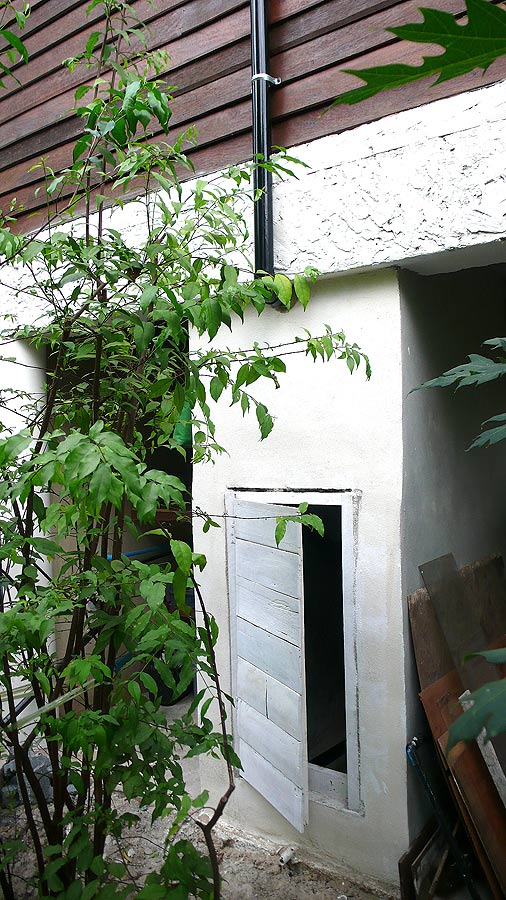
We looked through many, many plans online and in a book called the Barefoot Architect, and drew up plans to build a continuous composting system instead. This is the view of the outdoor space below our bathroom. When we built the house, we asked the builders to put a hole in the bathroom floor, which can be seen in the ceiling in the image above.
An engineer neighbor/friend helped us start the walls so they would stand strong.
Landry drilling holes to put in a ramp for the initial droppings.
And a few half-pipes below to maintain air in a pile if it is compacted.
Above, the ramp is in, and part of the front wall is in. We recruited our construction-savvy neighbor, Uncle Preecha -- who was one of the main guys on the team that built our house by hand -- to finish the masonry and stucco for a clean look.
The door is attached, walls stuccoed and painted, and a vent pipe above, to keep air flow throughout the system. The vent pipe is painted black to heat the air, lifting the air up the pipe and creating a vacuum to pull air in through a lower vent on the side. It gives the needed oxygen to the composting waste and also keeps the system odor-free.
Tuesday, January 03, 2012
Taking root
It's time for a recap because our house has changed so much since we moved in. As a reminder -- we purchased our small plot in November 2009, started construction in April 2010, and then officially moved in in July 2011. We've been here about six months now.
Above is a glimpse of our house from the "main road" in our neighborhood, a small sidewalk where neighbors on motorbike, tourists on bicycle and kiddies on foot pass each day.
Our massive front window, and the kitchen downstairs.
Landry has learned how to work with cement, so he put some traditional Thai tiles -- leftover from our bathroom -- at the bottom of our stairs outside. I lay a brick-lined gravel path to the kitchen.
Landry and I also finally put our back balcony railing up so that we can put laundered clothes out to dry without fearing a tumble into the canal below. One of the trees growing in front of our shower is a mangrove, called a "kak," which has great roots for preventing erosion. Its "fruit" are shaped like small torpedoes and drop from the tree, floating along in canals until they poke into a bank and take root.
We decided to take advantage of this southern exposure to plant directly under the back balcony a few enormous tomato plants that have nearly blocked Landry's office window. They live in a bed with a small brick wall that was Landry's first masonry project. To the left are birds of paradise that are watered when we shower.
The solar water heater is working well, but needs a clear cover to hold heat around these black pipes, as well as insulation around the water tank to keep the water warmer after sundown.
Our back balcony from inside.
Our living room furnished and well lived in.
On a shelf in our living room, a Buddhist monk statue from a relative in Thailand, binoculars from Bangalore, India, and a wooden yogurt container and a tapestry from Afghanistan.
Ultraman by our friend, ceramic sculptor Juan Santiago. Pink papier mache from Vietnam, just outside Ho Chi Minh City near the Kuchi tunnels, and his Afghan police hat from a market in Kabul.
Downstairs, our kitchen shelves, where most everything is well used.
We keep most of our dry ingredients -- rice, sugar, flour, beans -- in glass jars, and lately, we've been making our own homemade banana jam, chocolate pudding, applesauce and tomato sauce. The brownish-gray bowls on the left (bottom shelf) are from Seoul. The teapot-cups set in the center is from Ho Chi Minh City. The rest of the ceramics are from my dear friend Takako, who was clearing out decades-old dishes from her home.
Thanks to Alisa's brother, Van, for some of the above photos.
Sunday, January 01, 2012
Sunday, December 18, 2011
New park near home
Decades ago, the government purchased a lot of land on the island from the villagers, so they could go buy farmland in less flood-prone areas -- or so our neighbors have told us. The government then built a dyke around the island and stopped the flooding. Our island would be kept green and lush and was dubbed the "lungs of Bangkok."
Now, several large swathes of government-owned land are being developed into a nature education center, with fruiting trees for humans and for birds! One area (not pictured here) has already been finished and has a lovely boardwalk through the jungle, with signs about our flora and fauna. Now another area, pictured above, is being turned into a park as well. Our house now has a park on either side of it, and if this park-building trend continues, we will be surrounded on the entire western and southwestern sides of our neighborhood by parks.
Subscribe to:
Posts (Atom)